Throughout history, the concept of infinity has been a subject of debate, contradiction, and ambiguity. Only in the last two centuries did the problem of infinity in mathematics become resolved and reach a point of respectability alongside the finite.
Beginning in antiquity, Zeno of Elea demonstrated that motion was an illusion. For instance, he said, if Achilles is running to catch up to a tortoise, he first must reach the point where the tortoise started. But once he reaches that point, the tortoise has already departed. This problem repeats itself over and over so that it is impossible for Achilles to catch the tortoise. Therefore, to ever see one object pass another in nature is merely an illusion.
Paradoxes like this baffled and amused philosophers for centuries. But in the 19th century, three German professors, Karl Weierstrass, Bernard Bolzano, and Georg Cantor changed the way we look at infinity.
But before we look at their work, let us first consider some very large numbers. For before the mind can grasp the infinite, it is helpful to have some concept of the very big.
The current National Debt of the United States is about 15 trillion dollars. To get a better visualization of this number, it helps to put it in terms of time. If you spend money at a rate of one dollar per second, it would take about 11 and 1/2 days to spend one million dollars. It would take 31.7 years to spend One Billion dollars, and 31.7 thousand years to spend one trillion dollars. $15 trillion would take 475 thousand years to spend at the rate of 1 dollar per second. Since history itself only goes back 6000 years, we can see what an enormous number this is. But as enormous as it is, it is still not infinite.
British astrophysicist Sir Arthur Eddington claims that there are exactly 136 * 2256 protons and an equal number of electrons in the universe. While this number is very large, it is still finite.
American mathematician Edward Kasner coined the term "googol," defined as a one followed by a hundred zeros. He went on to define a "googolplex" as a one followed by a googol zeros.
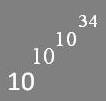
Another giant, even larger than a googolplex is Skewe’s number, which gives information about primes:
The total possible number of moves in a chess game is:

We must remember, however, that despite the enormity of these numbers, they are still finite. "Very big" and "infinite" are entirely different and there is no point where they begin to merge.
We must also keep in mind that infinity has a double aspect. There is the infinitely large and the infinitely small.
It was Karl Weierstrass who went to work on the infinitely small and concluded that it was not zero, yet it was smaller than any other quantity.
On the subject of the infinitely large, Bernard Bolzano was the first to treat it as a science problem, rather than a theological one. He cleared away most of the muddle, save Zeno, that had built up about the subject over the centuries and cleared the way for the clear thinking of Cantor.
Georg Cantor showed, through the concept of one-to-one correspondence, that different infinite classes had an equal number of elements. For instance, the number of integers, odd and even, is equal to the number of even integers:
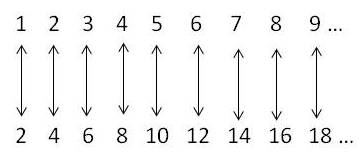
Cantor defined an infinite class as that which has the unique property that the whole is no greater than a subset of its parts. Furthermore, an infinite class can be put into one-to-one correspondence with a proper subset of itself. For example, if we take a 12-inch ruler, we see that the set of points on the ruler is infinite, for between any two points, there is a third point. The same rule applies to the first inch of the ruler. In this way, we can set up a one-to-one correspondence between the first inch and the entire foot. In the same way, a one-to-one correspondence can be set up between the set of points on a pin head and the set of points in the whole universe! This same principle applies to time as well as space.
Cantor said that since infinite classes could be put into one-to-one correspondence, they were countable or denumerably infinite or transfinite. The symbol (Aleph-Null) was used to represent transfinite numbers.
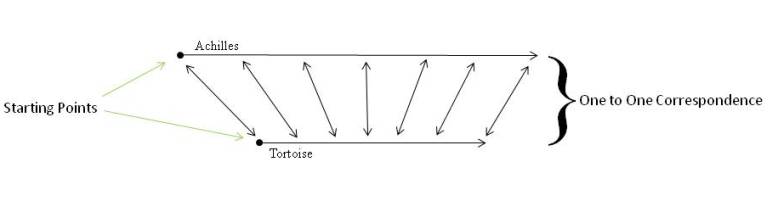
To explain away Zeno’s motion paradox, Cantor said that Achilles’ path is much longer than the tortoise’s path. Achilles may go further than the tortoise without actually touching more points.
For example,
We have the infinitely small as well as the infinitely large. On the large side, we cannot imagine how the universe can have a spatial limit, but we also cannot imagine how it can go on indefinitely. On the small side, we cannot imagine something which is not made of something else. So science has found that the atoms which make up everything are in turn comprised of protons, neutrons and electrons, which are in turn comprised of quarks. It should not be surprising when it is announced that quarks are made of something yet unnamed.
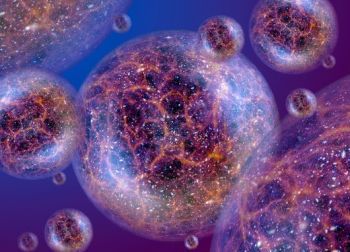
The Big Bang Theory has been somewhat refined over the past couple decades in light of new data showing that the galaxies emanating outward from the central point of the Big Bang are actually speeding up rather than slowing down (see Dark Energy). The old Expansion-Contraction theory, based on the Big Bang theory, postulated that as the impetus of the Big Bang's explosion lessened, gravity would become the more dominant of the two forces and start pulling the galaxies back together toward a center, where they would all collide and explode again and the cycle would repeat. But this can't be possible if the rate of galaxial movement is increasing. So the expansion-contraction theory is definitely put to rest. The Big Bang theory is still on essentially solid ground, but other theories are at least modifying it, suggesting that it may have been something of a "local" explosion. Relatively speaking, it happened in our local neighborhood, the neighborhood which our limited instruments are able to see. The possibility exists for there to be other Big Bangs creating other "universes", all of which are part of a greater "multiverse." It is further possible for other universes to be governed by different laws of physics, or even to be made up of entirely different elements. Essentially, we are in a multiverse which is much vaster and varied than previously thought.
So here we are on a planet revolving around a star, which revolves around a galaxy, which is moving through a universe, which itself is part of a multiverse. And, as stated before, we cannot perceive of something not being made of something else (leading us further and further into the infinitely small), and we cannot perceive of a Universe with an end (the infinitely large). The two come together to present the most apparent answer: everything is a part of something else, infinitely. Picture our multiverse clustered with other multiverses that are contained within something even larger, and that thing and others like it contained within something larger still, and on and on infinitely.
And what about time? If the Big Bang is merely one among many, then the theory that time began with the Big Bang goes out the window. For how could time exist in one place and not another? It seems wholly illogical. Doesn't it make more sense that the universe would be infinite in the 4th dimension as it is in the other three? Einstein agreed that time was the 4th dimension. Why would a universe be infinite in only 3 of its 4 dimensions? It makes logical sense that the Universe is infinite temporally as well as spatially. It has always been here, and the Big Bang was a local explosion in our sector of it.
Once you accept the idea of a universe with no beginning, theories of the evolution of life take on whole different possibilities. For in an infinite period of time, it is possible to evolve from the meekest amoeba to something we might regard as a god. And an infinite amount of time would enable this to have happened repeatedly already. In fact, in an infinite amount of time, this could have already happened an infinite number of times!
So take a look at whatever is before you, taking into account that whatever it is, it is made up of the infinitely small. In an infinitely large universe comprised of the infinitely small, what we have is an infinity of infinities. Along those same lines, and as Cantor points out, a subset of infinity is itself an infinity. Looked at this way, again we have an infinity of infinities.
Bibliography
1. Kasner and Newman, Mathematics and the Imagination, Chapter 2 Beyond the Googol, pgs. 27-64, Simon and Schuster, New York, 1940.
2. Poincaré, Math and Sciences - Last Essays, Chapter 4 The Logic of Infinity, pgs. 45-64, Translated by John W. Bolduc, Dover Publications, Inc., 1963.
3. The Mathematical Works of Bernard Bolzano - Translated and edited by Steve Russ - Oxford, Oxford University Press, 2004.
4. 1933. The Expanding Universe: Astronomy's 'Great Debate', 1900-1931. Cambridge University Press.
5. Wright, E.L. (9 May 2009). "What is the evidence for the Big Bang?". Frequently Asked Questions in Cosmology. UCLA, Division of Astronomy and Astrophysics.
6. Kragh, H. (1996). Cosmology and Controversy. Princeton (NJ): Princeton University Press.
7. Davies, P.C.W. (1992). The Mind of God: The scientific basis for a rational world. Simon & Schuster.