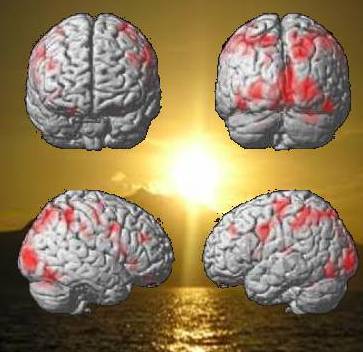
The Secret of Eternal Life is a novel I intend to publish in book form. As such, I won't be posting the entire story. Presented here is the opening scene. Enjoy.
Dr. Felix Sheng sat at the head table going over his notes. He was about to be introduced to give a presentation to the annual convention of the American Association of Neurological Surgeons, more commonly referred to as the AANS. Some of the four hundred or so attendees had read a recent article by Dr. Sheng in the Journal of Neurosurgery, the official publication of the AANS for nearly a century. Most of the doctors in the audience, however, had not the slightest idea that what they were about to hear would bring about a revolutionary change in human development and the future course of history.
Dr. Sheng was introduced by the President of the AANS, Dr. Anil Patel.
"And now," said Dr. Patel, "to present us with his findings using what appears to be a breakthrough procedure, the esteemed Dr. Felix Sheng." A round of polite applause emanated from the audience as Dr. Sheng stood and approached the podium. Behind him, the wall, which heretofore had displayed "Welcome to AANS 2043" changed to display an image of two human brains side by side. As Dr. Sheng spoke, he manipulated the display through controls built into the podium. Audience members also had the option of watching the presentation or Dr. Sheng, or both, through applications on various hand-held devices.
"Good afternoon everyone," he began. "Some of you may be aware already of my research with the International Genetics Project. Some of you may also have seen the latest report of the IGP in the Journal this past February. The rest of you may be wondering what a brain surgeon is doing hobnobbing with a bunch of crazy geneticists."
There was a smattering of laughter from the audience. Dr. Sheng continued.
"Our friends in the world of biology and genetics have made great strides in the process of cloning individual body parts in just the past few years. We've already seen how we have the ability to replace organs, joints, bone tissue, teeth, and just about everything else. If someone needs a new liver, geneticists can clone a new one. If someone has gone blind, new eyes can be cloned and surgically put in place. Any malfunctioning or diseased body part can be replaced. We've already seen how the process has been perfected to the point where a mere sample of DNA obtained from any part of a patient's body can be used to clone a specific needed part. None of this should be a surprise to anyone here today, as stories of successful organ cloning and their subsequent transplants have been prominent in the news these past 5 years. We find ourselves in the midst of a wondrous new world where health is greatly improved and lives are greatly extended. Up to this point, it has seemed that the only thing preventing people from living virtually forever has been the deterioration of the brain that comes with aging, as well as the myriad of diseases that destroy brain functionality.
"Cloning a brain is the same process as cloning any other body part. But there is a huge difference in the result. The cloned brain is like an empty slate. You can replace the old brain with the new cloned brain, but you would not be you since all your memories stay with the dying brain. Experiments with laboratory animals have demonstrated that a mammal with a new cloned brain is an infant all over again. It must re-learn everything it used to know. So for a human being to remain who they are and to retain their same personality, a way would have to be found to transfer the memories of the old brain into the new cloned brain. This would seem like an impossible task. At least it did up until now.
The audience audibly perked up. Attendees looked back and forth at each other with incredulous expressions. In the press seating area, reporter Vienna D'Alfonso of UWN News was gauging the reaction when journalism intern Maddy Sebastian leaned over and said, "The lab animals angle. Maybe an expose on the cruelty of forcing an adult animal into infancy again. You think he used monkeys? The higher up the food chain, the better the story plays."
"Maddy," said Vienna, while looking at her UltraPhone, and then up at the podium again. "Did you hear what he said after that?"
"What?" said the intern.
"I think he said they found a way to keep people alive... forever," said Vienna.
Dr. Sheng continued on with his speech accompanied by the audio-visual presentation behind him. The speech and prepared presentation explained in great detail the process named "memory transference". The process, involving a combination of direct brain-to-brain suturing and connections through nano-neuron tubes, had indeed been proven to work. It was first used on test animals. When it was seen that such animals were not reverting to an entirely infantile state, terminally ill human volunteers were used. Some of the early results had been tragic, but as the process was refined and perfected, the doctors found they could transfer most memories most of the time. Dr. Sheng pointed out that they were learning much more about the brain through the process and that they were finding better ways of connecting the "memory centers" of the brain, improving the quantity of memory patients could absorb into their new brains.
"So essentially, yes," Dr. Sheng continued, "Once the process has been perfected, and it is very close to perfection now, a person need never die. All parts can be periodically replaced, including the brain. One caveat perhaps is that the brain must not be damaged for memory transference to work. Someone with a mortal gunshot wound to the head, for instance, would be unrecoverable. The memory centers must be intact. Otherwise there is nothing to transfer. Also, the subject needs to be alive, as a certain amount of brain exercises performed by the subject generates brain activity which assists in the transference. So yes, our research has successfully conquered death, but only if you keep your brain intact."
Dr. Sheng tapped the side of his head and smiled as he said this last part. The presentation behind him indicated it was the end. The audience of neurosurgeons began applauding and then stood and cheered. Some in this group of normally very serious clinical minds began hooting and whistling. They had good reason to be excited. The ultimate and age-old goal of medicine had at last been achieved. Immortality was at hand.
In the press section, Vienna and Maddy remained seated. While Vienna's fingers rapidly tapped keys on her UltraPhone, she explained to the intern what she was doing.
"I'm submitting the video and the story to the International desk, " she said. "This isn't going to run in the science segment."
"No?" asked Maddy.
"No," said Vienna, "If this isn't today's top story, then we're not a news network."